“Like Day and Night”: How Zaman International Modernized with Exponent Case Management
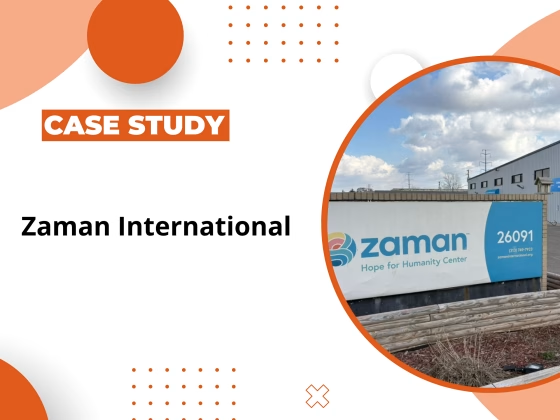
Zaman International is a nonprofit organization based in Inkster, Michigan that empowers women and children facing poverty. The organization operates multiple programs locally that span basic needs support, education, vocational training, workforce development, and a health center, helping families move toward self-sufficiency. They also have several international crisis relief programs. Over its 30-year history, Zaman has reached over 5 million women, children, and individuals in need, providing critical resources that build stability, independence, and pathways to long-term success.
Highlights
- Reduced End-of-Year Reporting from 4 Weeks to Minutes: Annual data compilation that once consumed a full month can now be pulled in minutes
- From Missing Records to Data Confidence: Weekly QA dashboards replaced twice-yearly audits, eliminating hundreds of missing records and building trust in every report”
- Data-Driven Service Design: Improved cross-program visibility enabled Zaman to test and refine how clients move between basic needs and workforce development, designing more effective service pathways
Situation
Data was scattered across spreadsheets with no cross-departmental visibility
Zaman started with Google Sheets and Excel spreadsheets, with each department building its own tracking methods. “Every department was using different platforms, kind of building what they needed for that time,” explained Gigi Salka, Chief Workforce Development Officer. “The most important thing is linking data. If you have different cases or different programs, it’s hard to link the data across disconnected systems.”
This fragmentation meant staff in workforce development had no visibility into what services a client was receiving through their basic needs program, and vice versa. “We needed to be able to see the whole picture, which we did not have before,” Gigi explained. The organization had no way to analyze how clients moved between programs or whether one service led to another.
The existing database couldn’t handle growth
As the organization grew, they moved to Microsoft Access, but it couldn’t keep up. “Microsoft Access was outdated and used to crash whenever two or three users worked on it,” Khansa Al-Gassid, Technology Coordinator, explained. “As we grew, we had at least 10 users at a time, so we had that issue of the system crashing every time we started to use it.”
Manual reporting consumed a month of staff time
End-of-year reporting required Gigi to spend an entire month collecting data from multiple sources and reformatting it for different stakeholders. “Maybe you don’t really know how long it’s supposed to take you to collect that data,” she said. “You just say, this is what I know, so this is normal.”
Data quality issues went undetected for months
The organization met with program directors twice a year to review data. By then, staff couldn’t remember why records had issues. “It’s a bit hard to remember why these people came in January or February,” said Khansa. Without timely visibility into data quality, trust in reporting suffered. “There is no point to having so much data if you can’t manipulate it and filter it and organize it in a way that you trust,” she added.
First database vendor couldn’t keep pace with growth
Zaman’s first attempt at a database solution, Seeladora, was outgrown within six months. As their program offerings grew, they quickly hit the ceiling with Seeladora and the system couldn’t support their evolving needs. “We needed a more scalable solution where we couldn’t hit the ceiling,” Gigi said.
Solution
Gigi advocated for a Salesforce-based solution, recognizing it as the industry standard with the scalability Zaman needed. “We don’t know where you are going to be in the future, and we need something that can grow with us,” she explained.
Zaman needed a system to manage data across all their major programs: case management, BOOST workforce development, the health clinic, and employee assistance services.
The organization selected Exponent Case Management (ECM) for its cross-departmental functionality, flexible reporting capabilities, and the autonomy it provided to customize the system without constant vendor dependency. “We really needed a lot of flexibility in reporting, and we knew that our reporting was always changing,” Gigi said. “We needed the ability to create and manage the reports ourselves instead of having just canned reports.”
Results
Reporting in service of the mission, not a burden on it
When a stakeholder recently requested five years of trend data, Gigi was asked how long it would take. “Give me 10 minutes,” she responded. What once consumed a full month of year-end data compilation now happens in minutes, freeing staff to focus on the families they serve rather than chasing spreadsheets.
Grant writing is now significantly streamlined since implementing ECM. “Our grant writer needs to know how many females live in this area, what language people speak, or the ages of a group in a specific zip code. We can now pull that data quickly and easily,” Khansa said.
A culture of data hygiene that builds trust
Khansa implemented weekly QA dashboards that flag missing or inconsistent data before it becomes a problem. “Before, we used to look at data once a year or twice a year. By that time, case managers may not accurately remember why this client was labeled as attended but doesn’t have any units of services,” she explained. “With the weekly reports, I no longer have hundreds of records with missing information.”
This shift from reactive audits to proactive data hygiene has transformed how the organization relates to its data. Staff catch and correct issues while the context is still fresh, building confidence that what they report reflects reality. Funders are also beginning to ask more questions around data hygiene. They want to know “How do you collect your data? How do you manage it? Gigi said. Zaman can now answer those questions with confidence.
Data-driven insights that shape better programs
With visibility across all programs, Zaman can now see the full picture of each client’s journey. “We have access to see where the client is in each one of those programs,” Gigi said. “The ability to read the progress notes, the case notes to see what trainings they’re in, what services they’re getting from the other departments has been very helpful.” At the same time, ECM’s security features ensure sensitive information stays protected. Employee assistance cases remain private from other staff. “We love that privacy feature,” Khansa added.
This visibility didn’t just improve coordination; it enabled Zaman to rethink how they design services Gigi explained. The organization tested different pathways for how clients move between basic needs and workforce development. These insights led to the creation of the RISE program, which identifies basic needs clients who are ready for workforce development.
Intervening before clients fall through the cracks
Having data at their fingertips allows staff to track client progress in real time and mitigate potential risks before they become an issue. “If I have an eye on her throughout the year, every week, every month, I can identify the problem and see how I can solve it,” Gigi explained. “You’re mitigating risk before it becomes an issue.”
This proactive approach changes the nature of case management from reactive problem-solving to early intervention. “It makes you ask the question. Is it transportation? Is your computer not working? What’s going on?” Gigi said. “It identifies any problem early-on.
A partner who builds capacity, not dependency
Zaman values having a dedicated customer success representative who understands their programs. The contrast with other vendors is stark. “With other vendors, I’d explain my issue, hear nothing for months, then start over with a new account manager. No progress would be made,” Khansa said. “With Exponent, I have a dedicated support rep who already understands our work. They not only proactively follow-up, but what I appreciate most is they don’t just solve problems; They’re trying to teach me how to do it.
“I love Exponent’s customer service. They’re very patient,” Khansa said.
Words of Advice
Comparing ECM to their previous systems, Khansa’s assessment is simple: “It’s like day and night.” For organizations still relying on spreadsheets or rigid case management software, Gigi’s advice is straightforward: “You have to be forward thinking. You don’t know what you’re going to need in the future. With ECM, it’s a very holistic approach to case management that grows with you.”
Key Testimonials:
“I can’t tell you today the report that I need tomorrow. Having immense flexibility in reporting was what sold us on ECM.” — Gigi Salka, Chief Workforce Development Officer
On Exponent support:
“With other vendors, I’d explain my issue, hear nothing for months, then start over with a new account manager. I love Exponent’s customer service. They’re very patient. I have a dedicated support rep who already understands our work. They not only proactively follow-up, but what I appreciate most is they don’t just solve problems; They’re trying to teach me how to do it.” – Khansa Al-Gassid, Technology Coordinator
On Funders & Data Hygiene:
“Funders are starting to ask, how do you collect your data? Where is it? How do you manage it? Who’s in charge of it? They want to know your data hygiene. With ECM, we can easily answer those questions with confidence in our data practices.”- Gigi
On ECM Reporting:
“We really needed a lot of flexibility in reporting, and we knew that our reporting was always changing. With ECM, we have the ability to create and manage the reports ourselves instead of having just canned reports.” – Gigi
Advice to Other Organizations:
“You have to be forward thinking. You don’t know what you’re going to need in the future. With ECM, it’s a very holistic approach to case management that grows with you.” – Gigi